
On Philanthropic Infrastructure
Today’s “Philanthropic Confidential” submission understood the assignment and did not pull any punches:
“How did Trust-Based Philanthropy—developed by three coastal people—[become] the gold standard manual of how to ‘do it right’? Local funders have been working that way for decades. Ignorance or empire building?” —Allen Smart
I invited Shaady Salehi, the co-executive director of the Trust-Based Philanthropy project, to answer Allen’s question with me via the video below. We address some important things, such as Are you a coastal elite? How annoying is this question to you? Most importantly, what is your response to this salient, incisive inquiry? Check it out:
Additionally, beyond Trust-Based Philanthropy, I have more thoughts (and a hand-drawn graphic!) on our expansive philanthropic infrastructure writ large. If you like what you are seeing, please feel free to submit a question below.

Dear Allen,
First, I share your frustrations, and I like your question. A lot.
Second, a wrinkle: I like Trust-Based Philanthropy (TBP). A lot.
Finally, another quagmire: I do not believe these are contradictory perspectives.
TBP is a part of an expansive philanthropic ecosystem that exists because we have to teach foundations how to do normal human things—like not being control-driven weirdos in relationships. As I have previously written, the corporate origins of the field and the institutionalization of philanthropy prevent us from living into philanthropy’s relationship-driven intentions. After all, you wouldn’t start a friendship with another human by making them submit a letter of interest and then a proposal; then subject them to a slog of questions; then ask more questions they already answered; then wait for a vague period of time—all before you even begin the relationship.
And if you do, we need to talk because, respectfully, you may suck.
To your point, Allen, the foundation behemoths among us—often on the coasts—have to relearn what excellent local funders and rural funders often practice. This is profoundly irritating yet important work. I have sat through many training sessions emphasizing that funders should follow through on what they say. I have consistently wondered, “Are we in the Zoolander Center for Kids Who Can’t Read Good and Wanna Learn to Do Other Stuff Good Too?” Yet, the work of organizations like TBP remains as long as the corporate-influenced foundation overlords (and hired henchmen like me) continue to demand incongruous quarterly earnings-like reports to track the long, undulating, and arduous work it takes for communities to flourish on their own terms.
With that said, Allen, your question rightfully interrogates the philanthropic ecosystem’s “empire building.” If institutional philanthropy has corporate origins, it is also mimicking the corporate models of the top-down structure influence—charismatic (and often male) personalities on the pulpit, expensive frameworks, and an ever-expanding landscape of philanthropy-serving organizations that offer consultants, conferences, more conferences, and convenings that are basically tiny conferences.
In Anand Giridharadas’ oft-referenced Winner Takes All, this broad empire (extending beyond institutional philanthropy) is called “MarketWorld”—defined as “an unending chain of tent revivals around the world” focused on “doing well for yourself by doing good for others.” His examples include thought leadership spaces like TED, Aspen, and South by Southwest.
I have my own philanthropy-specific version of MarketWorld called “Foundationlandia!,” which I mapped below:
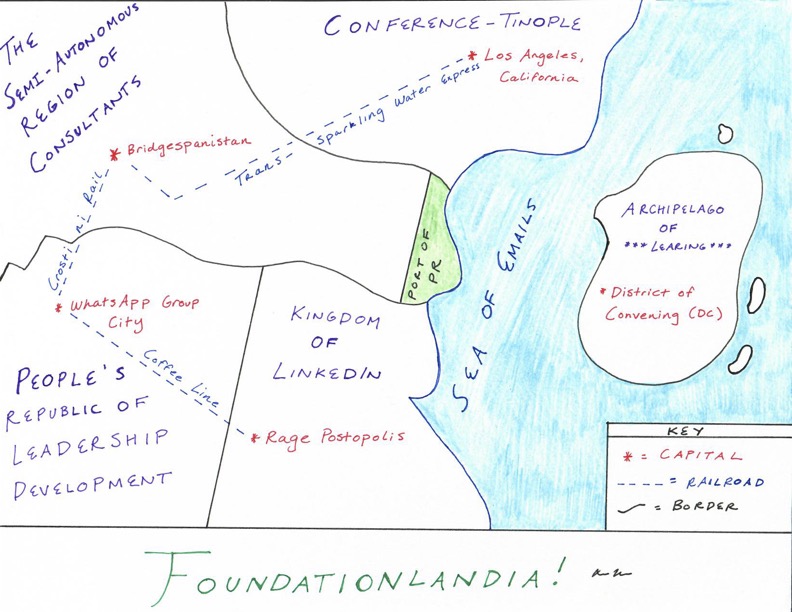

Narnia-inspired maps aside, unlike Giridharadas, I believe there are justifications beyond navel gazing and self-promotion for some of the philanthropic tent revivals. The field needs more coordination, communication, aligned funding, and standardization in a field of disparate actors. However, for a field whose sole obligation is to give out money, there’s convincing evidence that we are not living up to our grandiose visions. For example, according to the most recent Center for Effective Philanthropy survey of nonprofits, in the face of historical federal cuts, payouts among participating foundations increased just 2%. As a point of comparison, the U.S. inflation rate in 2025 was higher at 2.7%. Additionally, in his upcoming book CONTROL: Why Big Giving Falls Short, Stupski CEO Glen Galaich shares that for all our efforts, some estimate that only 10% of the $1.5 trillion funds in philanthropy have been influenced by the well-intentioned ecosystem that philanthropy has created. Full disclosure: Glen is my boss, writes my performance reviews, and loudly speaks in the office next to mine.
Allen, I’m not proposing that we shut down every philanthropic-serving organization or stop hiring consultants. Rather, I believe we should more closely interrogate the size, scope, and (most of all) cost of said offerings because what we spend internally within the field means less goes out to community-serving grantees. This beckons some questions: Which players in the ecosystem are setting a coordinated vision of getting more money into communities? What’s working? What initiatives are self-aggrandizing, individually promotional, and travel heavy carbon waste? What do we need to sunset?
Without this level of reflection and alignment, what we are left with is more folks like you, Allen—people who have decades of experience doing the work without needing to be bludgeoned with overpriced Microsoft SmartArt masquerading as frameworks who are rightfully questioning the system. To offer a concrete example, Stupski Foundation is finalizing our list of memberships from a short list of 28 organizations, all of which require their own membership fees and grants.
Aside from my cousins, I don’t have 28 of anything in my life—pants, underwear, friends, aspirations, plastic-free brain cells, etc. What I do have are many people—from across the coasts, in urban and rural communities, in places like Minnesota and Ohio—who are hungry for and deserving of those dollars.
Thank you for your question, Allen!
Jen
