
I got slimed…and I deserved it.
This edition of Philanthropy Confidential is brought to you by an important question from our spend-down kin at the Kataly Foundation for their “F Word” series. Contrary to what I thought, the “F word” question is not about “frogs.” Rather:


How have you failed?


My immediate response to this question was another inquiry: What, in institutional philanthropy, isn’t a failure? I have written and spoken about how the existence of institutional philanthropy is a policy aberration — more specifically America’s inability to live into the promises of the Reconstruction era. In the absence of robust democratic systems for all Americans, we now depend on extractive billionaire philanthropy for basic services. With this context, failure is the default in this field.
However, my communications director constantly reminds me that “Everything sucks — including you!” is not a very motivating message (even if you play this song while saying it).
As we hack away at this tax shelter, I believe it’s important to heed the Kataly Foundation’s call for reflection about our institutional failures. In that spirit, I asked Lori Beth Way — the vice provost of academic planning and dean of undergraduate education at San Francisco State University (SFSU) — to speak about many of the mistakes I made during our almost eight-year relationship. I did not want to repeat a common blunder I witness across philanthropy: foundations speaking on behalf of grantees. This is yet another form of power — narrative control.
As a grantee, Lori Beth is in a far more vulnerable position than me. Before filming, she wondered if appearing on camera would affect her other grantmaking relationships. That our grantees have to think through the implications of giving constructive feedback is indicative of a fieldwide issue: Without getting real information about our failures, foundations will repeat the same mistakes over and over again.
For example, by the time I started at the Stupski Foundation, we had a nearly two-decade and multimillion-dollar track record in education philanthropy. Rarely did I hear our foundation board and staff internally reflect on our failures in the education ecosystem — how did we contribute to the state of education? What did we learn? How can we do better?
I call this the “Funder vs. Grantee” problem positioning, which frames the grantee as the culprit of failure. This framing is very different from an ecosystems approach. To illustrate, here’s a bad hand-drawn graphic of stuff I made up with a requisite Taylor Swift reference:
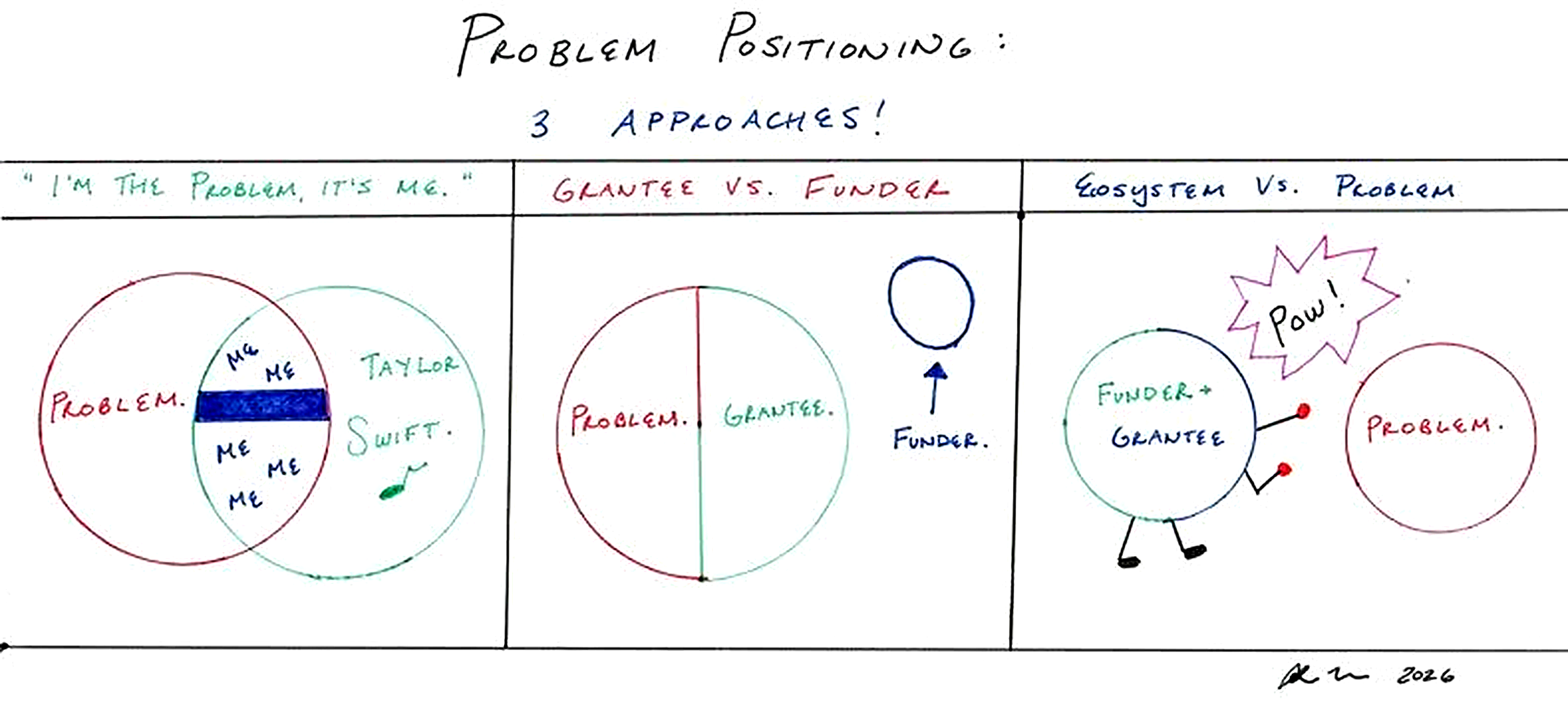
In the absence of reflecting about our foundation’s role in a system, we did something else: We created burdensome practices for grantees to obfuscate historical mistakes that we were a part of. I look back at this period of time — the first two years of my time at the Stupski Foundation — and I think about the grantmaking culture, which went a little bit like this:
- A lot of conversation about how working in education is hard, which resulted in me constantly biting my tongue from saying, well duh.
- Requests for outcomes despite the fact that we just gave away the grant, which required me to summon the energy of 1,000 cognitive behavioral therapy sessions to explain that we should wait one school year to calculate graduation rates.
- The “widgetification” of our grantmaking, which is funding education technologies (often sold by men who seem to never iron their shirts) for immediate quantitative metrics of success. You know, because we’re absolutely going to text nudge our way toward collective liberation!
At the time, I was angry at these practices and saw this behavior as the typical education program officer treatment. With time and distance, I now understand the roots of these actions, which aren’t intentionally nefarious. Quite simply, we were scared. Scared of failing. Scared of what it would take to invest in the students whom our education and economic systems have failed the most. Scared that this last chapter of the Stupski Foundation — which had already closed before — would end like the previous passages: unceremoniously with vague narratives about our work in education.
Worst of all: We were scared of schools.
To some extent, I understand why. Schools are difficult and complex systems. I’ve had to have tough conversations on grant “progress” — often at the grantees’ request. However, this fear of failure impacts our grantees. I look back at practices, such as forcing an external evaluation on the SFSU team that it did not ask for. In retrospect, we mined for quantitative progress to assuage fear — a fear that remained even though Lori Beth won California State University’s Outstanding Staff Performance Award (a system that employs more than 60,000 people!) the year we issued the grant.
Instead, the SFSU team and I spent at least 15 hours talking about the evaluation — a figure that doesn’t even include the time the university spent collecting information for and meeting with the evaluators. And this was amid the pandemic when the SFSU team had a lot going on.
In the years since, the Stupski board made the important decision to right-size its role. However, the big change was that the SFSU team — in its patience and courageous feedback — helped me rework the grant terms and reimagine our partnership.
Ironically, the moment I let go of control is the moment I developed a relationship that most program officers dream of: The SFSU team began reaching out to talk through challenges. Lori Beth and I discussed how I could help the SFSU team advocate for its campus needs. I witnessed the team fly with success and brave its own challenges. I got to visit its beautiful new advising center — a culminating moment for one of my favorite grants. This was so much better than being a panicked metrics gofer.
To Lori Beth, thank you for your determination and all that you do. I never said this during our conversation, but I’ll write it here: I am truly sorry.
I don’t want to repeat this mistake again. I encourage foundations to have the conversation about failure not just through communications pieces but with our internal stakeholders. The call from the Kataly Foundation is very important. The question we normally ask inside foundations must be inverted — not “How have our grantees failed?” but “How have we failed?” Only when this inversion transpires can we truly unburden our grantees from the practices that only serve to shield us from our mistakes.
Jen
P.S. If you have a question or rant you’d like to share, please do so below. Even if I do not write to you via this column, I will reply to you via email.
